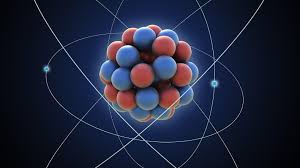
We know , Atoms are extremely small particles. According to Dalton’s atomic theory, it can not be further devided . But now it is possible to devide it ,and it is known to all that atoms can be further devided into more particles ( Electron,Proton, Neutron ). But, Concept of Atomic mass is only related to a atom.
THINK
Can you guess ?, how small these particles ( Atoms ) ,and how much the mass of these particles would be !

GUESS
It may shook you that the mass of a hydrogen atom is 0.0000000000000000000000016736 g . It can be written as 1.16736×10^-24 which is too small to observe by naked eyes. Nevertheless, it is now possible to determine it with the help of modern technics.

You can guess it relatively comparing with the mass of a seed. The mass of a seed may be …… Then , think how small these particles are !
TO MAKE THE CALCULATIONS EASY
In most cases , it is so important to determine the mass of an atom . But the actual mass is too small to understand strongly. This means, a large digits number can make us bore. When we use these actual mass of atom to calculate something important , we may be on the hang in the balance with the solution after the calculation involved in it.

To make these easy , we can express these masses with the help of the the term ‘ Relative mass ‘ . So, the Scientists carry the word ‘ Relative mass ‘ . But , it was the problem of the Scientists that what should be the relative mass to make these easy as much as possible ?
# IT IS VERY IMPORTANT TO KNOW, WHAT THIS ‘ RELATIVE ‘ MEANS…
We have come to see , the word ‘ RELATIVE ‘ in many respects.
If it is difficult to determine the exact amount of a thing , it may be the mass or may be others else. Sometimes, exact amount can make us hard to understand the physical amount of it. And , how much the amount may be , it is difficult to understand with respect to other. So , a concept, Relative is applied to make them difficulty easy. Actually, it is that amount of the thing with respect to a standard amount of a common thing. It should be well defined in any time and at any place. Infact, most of the usual things are calculated by the term Relative. For example, for determining the mass of an object is related to the international preservative , a prototype of platinum – iridium cylinder.
Like this , the exact mass of various atoms are hard to compare one with another. For simplicity , the term Relative is used.
Scientists were very aware of choosing a standard atom for the term Relative. They determined some characteristics of the particular atom which would become the standard relative. These characteristics were —
1. It should be reactive with the others atoms.
2. It should not be highly reactive to make other elements destructible.
3. It should be found in everywhere.
4. It should be such like an atom as it can form a great numbers of compound by combining with the others atoms.
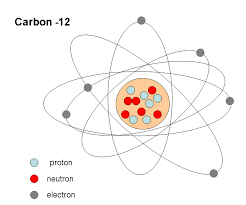
The above factors occure highly in the atom of Carbon. So, Carbon is selected as the standard relative mass of atoms. Before, taking Carbon, Hydrogen was selected and then Oxygen was selected. But , most of these three compounds ( Hydrogen, Oxygen and Carbon ) , Carbon behaves as the factors that Scientists had determined.
Carbon naturally occure in three isotopes ( Different actual atomic masses of the same element ). But, Carbon – 12 is selected due to the fact that it is found on the Earth most.
At present , all the atomic mass are relatively related to Carbon -12 atom.
HOW TO DEFINE ATOMIC MASS OF A PARTICULAR ATOM
Mass of an atom of Carbon = 12 amu
It has been already understood that the atomic mass of an atom is related to the mass of Carbon – 12 atom. It is assumed that a Carbon – 12 has the mass of 12 amu. So, the atomic mass of Carbon is 12 amu ( for Carbon – 12 atom ) , Where amu is the unit of Atomic mass.
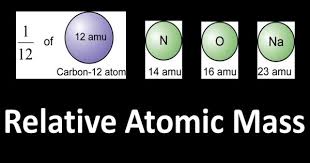
Mass of an atom of Carbon = 12 amu
Mass of 1/12 parts of an
atom of Carbon = 1/12 × 12 amu
= 1 amu
Mass of an atom of that element
= Actual mass of the atom / (1/12
mass of an atom of Carbon )
= Actual mass of the atom / ( 1 amu )
1 amu = ? gram
amu is the unit of Atomic mass of an atom. This unit can be written in the form of gram which is the SI unit of mass.
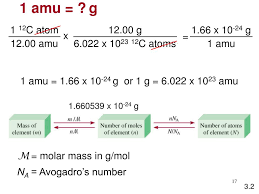
We use amu to indicate that the mass of the atom is determined relatively. It means the relative mass , with respect to Carbon. But when we use gram after the magnitude or to indicate that the mass of the atom is in the actual mass not in relative.
By using some sofisticated techniques, it is possible to determine the actual mass of an atom of Carbon.
Actual mass of an atom of Carbon
= 1.992672×10^-23 gram
= 12 amu
So,
1 amu = 1.992627 × 10^-23 g / 12 amu
= 1.66056 × 10^-24 g
1 amu = 1.66056 × 10^-24 g
WHAT TO REMEMBER – ACTUAL ATOMIC MASS / RELATIVE ATOMIC MASS

We have seen that the relative mass are the those numbers which are commonly used everywhere. But the actual atomic mass are difficult to remeber for a various number of atoms present on the Earth.
So for simplicity, Relative atomic masses are remembered by the people. If we remember relative atomic mass , then we can easily determine the actual atomic mass of that atom doing a simple calculation.
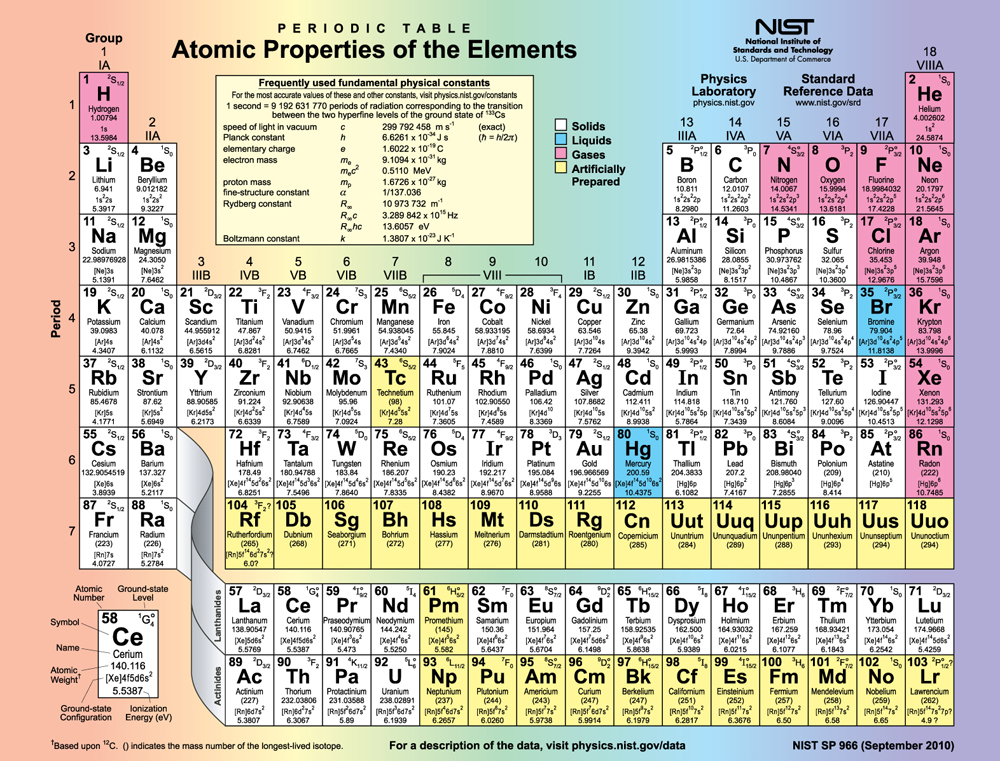
Commonly used relative atomic masses. ( Approximately )
Hydrogen = 1 amu
Helium = 4 amu
Carbon = 12 amu
Nitrogen = 14 amu
Oxygen = 16 amu
Sodium = 23 amu
Magnesium = 24 amu
Aluminum = 27 amu
Clorine = 35.5 amu
Calcium = 40 amu
Mind IT
Atomic mass of an element ( H, He ,…etc) is the only mass of an atom of that element.

An element consists of a large number of atoms. But , the atomic mass of an element only means the mass of an atom not the whole number of atoms present in the element simultaneously.
For example, atomic mass of Oxygen element is 16 amu. In the form of gram it becomes 2.656896 × 10^-23 g. It is not mass of the whole Oxygen. It is the mass of an atom of Oxygen. Oxygen comprises a large number of atoms of such masses .
amu is replaced by u
At present, unit of Atomic mass amu is replaced by u. It doesn’t change the magnitude of the mass.
Atomic mass of Oxygen = 16 u
FULL FORM OF UNIT OF ATOMIC MASS
Full form of amu is Atomic mass unit
Full form of u is UNIFIED MASS
# I shall carry in the next topics , the concept of other terms such as Atomic number, Molecular mass, Avg. Atomic mass, Gram atomic mass…etc.
# If you have felt the advantage of the above topic , then please visit my site again and inform to your friends and relatives.
# Comment your spaculation about the atomic mass concept from the above topic.
# Like the post.
# Follow my site to get more such topics related to Science.
THANK YOU

 Science